
My most obscure grave visited thus far, and for good reason.
Lieutenant General Sir Adrian Paul Ghislain Carton de Wiart is “The Man Who Wouldn’t Die.”
He was a recipient of the Victoria Cross, the United Kingdom’s highest decoration for valor “in the face of the enemy,” and veteran of the Boer War, World War I, and World War II. Additional honors bestowed upon him include the Most Excellent Order of the British Empire, Most Honourable Order of the Bath, Most Distinguished Order of Saint Michael and Saint George, and the Distinguished Service Order.
Impressive, but it is the reasons behind his “unkillable soldier” moniker that make jaws drop.
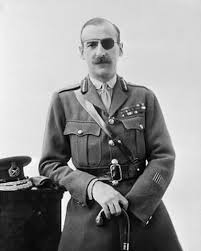
Throughout his service, de Wiart survived gunshot wounds to his ankle, leg, hip, groin, stomach, head, and face, which tore off part of his ear and left eye. Friend and fellow officer Hastings Ismay remarked, “I honestly believe that he regarded the loss of an eye as a blessing as it allowed him to get out of Somaliland to Europe where he thought the real action was.” Doctors gave de Wiart a glass eye, and he promptly tossed it out a taxi window, opting for his iconic eye patch instead.
An artillery barrage shattered his left hand, and when a field surgeon refused to amputate two dangling fingers, he tore them off himself and tried returning to duty. The entire hand would eventually need to be amputated.
How this man continued to be medically cleared to fight is beyond me, but alas, he pushed forward. With one eye and one hand, he fought ferociously at the Somme. It was there he earned his Victoria Cross, inspiring his men from the front, pulling grenade pins with his teeth and tossing them with his one good arm.
For all his brushes with death, it wouldn’t be the inhumanities of war that claimed de Wiart’s life. At the age of 83 on June 5, 1963, Adrian de Wiart passed away from natural causes. Twelve years earlier, de Wiart married his second wife, Joan, and settled in the quiet village of Carrigadrohid, in Aghinagh Parish, County Cork, Ireland. De Wiart was buried on the grounds of the ruins of the Church of Ireland in Aghinagh. Joan would live until the age of 103 and join him in 2006.
The trip to Carrigadrohid to visit de Wiart’s grave was easily my most obscure trek and one I shouldn’t forget anytime soon. For those not familiar with the country roads of Ireland, it’s an adventure in itself! But on that day, the GPS was (relatively) cooperative and the sun was shining. When we arrived we were met with an ethereal quiet followed by a brief moment of panic. Finding a small patch of gravel to park, I immediately noticed a locked gate, medieval stone walls, and a lifetime of unruly vegetation doing its best to keep any visitors at bay. Fortunately we found a smaller gate open and were met with large Celtic crosses and faded stones enveloped in vines and ivy. The plot for Adrian and Joan is actually located immediately behind the rear wall of the church and easy to miss if not being sought. One could even describe it as lonely. I like to think for a man who spent his life surrounded by the noise and chaos of war, the peace and quiet of Aghinagh is exactly what he wanted.